StackFit · Fitness app concept · Ironhack
Fitting exercise into habits people already have
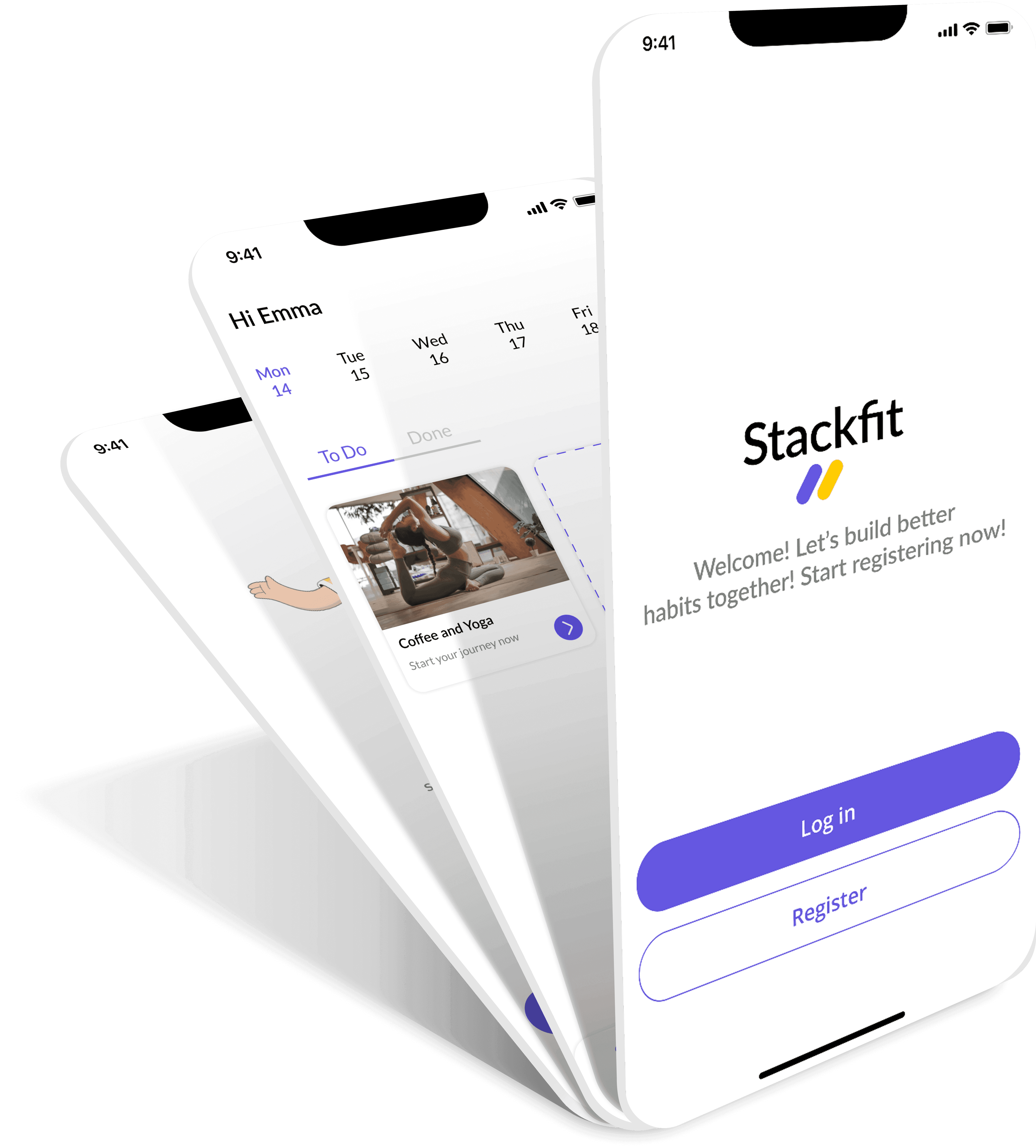
A concept app for busy young professionals who know exercise matters but can’t find the time. Instead of asking for an hour at the gym, StackFit links a short workout to something you already do every day, like your morning coffee or brushing your teeth.
Role
UX/UI Designer, team of 2
Duration
10-day sprint, Nov 2023
Platform
iOS app
Status
Concept, not built
01 Context
Short on time, and feeling guilty about it
The people we interviewed knew exercise was good for them. What they lacked was time. Between work and everything else, a workout was the first thing to go, and skipping it left them feeling lazy and guilty.
The brief was an app that helps them exercise regularly without needing a free hour. We built it on habit stacking: tying a new habit to one that already exists, so the existing habit becomes the reminder. Coffee becomes the cue for yoga, brushing your teeth the cue for squats.
02 Research
Four methods, one consistent answer
We were a team of two. We started with secondary research on habit formation and why people use fitness apps, then ran a survey, compared competitors and interviewed young professionals for 15 to 20 minutes each about how exercise fits into their week.
49
survey responses about exercise habits
15
interviews with young professionals
5
competitor apps compared, one scored against Nielsen’s heuristics
2.1 Survey
Before the interviews, 49 people answered a short survey to check the problem was real and who it belonged to.
79.6%
were aged 25 to 34
60%
would use an app with short workouts outside the gym that tracks progress
2.2 Competitive analysis
We compared five fitness apps on value proposition, audience, focus and tone. All of them are built around workout plans you have to make time for. None combined habit stacking with time management.
| Freeletics | Seven | Walkr | Sworkit | FitOn | |
|---|---|---|---|---|---|
| Value proposition | Holistic self-development, customisable, community | Custom plans, awards, community, motivation | Fun, motivational, calorie tracking, community | Fitness, mindfulness, prevention and nutrition | Workouts, nutrition, motivation, wellness, live coach |
| Audience | Men and women, 20–40 | Men and women, 20–30 | Anyone | Any age or gender | Any gender, 30–50 |
| Focus | HIIT workouts and diet | Custom workouts, diet, habits and motivation | More daily walking to reach new planets | Home workouts for everyone | Home workouts, from pilates to yoga and mindfulness |
| Slogan | Give your fitness a super boost. Maintain consistency. Get results. | Small habits lead to big changes. | Step into a healthier space | Total wellbeing made simple | A full gym & wellness coach. Always on. |
| Personality | Strong, powerful, urban | Young and playful | Fun, adventurous | Minimal, easy to use | Joyful and minimal |
2.3 Heuristic review
We scored Seven, the closest competitor, against Nielsen’s ten heuristics from 1 (minor) to 4 (serious). The three highest became things StackFit had to get right: clear progress through onboarding, feedback when something goes wrong, and screens with nothing extra on them.
| # | Heuristic | Severity | Finding |
|---|---|---|---|
| 01 | Visibility of system status | 4/4 | Onboarding is confusing: it’s hard to tell which step of the setup you’re on. |
| 02 | Match with the real world | 2/4 | Mostly familiar language, but some playful wording could confuse. Plainer copy would help in places. |
| 03 | User control and freedom | 1/4 | You can always go back, even from screens opened by mistake. |
| 04 | Consistency and standards | 2/4 | Consistent overall, with some alignment issues, mismatched CTA labels and photos mixed into an illustrated style. |
| 05 | Error prevention | 2/4 | Clear, but could be designed to be more visible. |
| 06 | Recognition rather than recall | 1/4 | Low memory load. Options are easy to see. |
| 07 | Flexibility and efficiency | 1/4 | Nothing to flag. |
| 08 | Aesthetic and minimalist design | 3/4 | Some dialogues carry information that isn’t relevant, for example in the training screens. |
| 09 | Help users recover from errors | 4/4 | Some sections prevent errors well, others give no feedback at all. |
| 10 | Help and documentation | 1/4 | Good help and documentation. |
2.4 Interviews
15 conversations of 15 to 20 minutes. We grouped the notes on an affinity map under eight themes, from workout times and product ideas to lack of time and feeling lazy, and three insights stood out.
Insight 01
People in their late 20s and 30s know exercise is good for their physical and mental health.
Insight 02
Busy schedules leave them little time to dedicate to working out.
Insight 03
Not exercising makes them feel lazy, and they notice it in their health and in how they perform in the rest of their lives.
“A product that helps me find time for short exercise sessions in my busy routine would be incredibly valuable.”
“I feel lazy at the end of the day if I haven’t exercised.”
“I’ve heard about micro-gym sessions. When you don’t have time, doing five squats is better than doing nothing.”
03 Define
Time was the barrier, not motivation to start
3.1 Empathy map
We turned the interview notes into an empathy map: what Emma says, does, hears and sees, and what she thinks and feels underneath. One need sat in the middle of it.
Says
What we heard her say
“I have no time to take care of myself.”
“I’m too tired to go hiking this weekend.”
“I love the mental boost and energy I have after exercising.”
“I want to get back to my previous fitness level.”
“I don’t want to feel so lazy anymore.”
Thinks & feels
Pains and gains
−Her schedule is so tight she can’t find time for anything else
−Overwhelmed by a stressful life
−Struggling with the activities she loves as her fitness declines
+Enjoy hiking and skiing
+Manage stress and anxiety better
+Lose a few kilos and feel better at work
Does
What she does today
Works full time and spends most of the day at the office
Puts work and studies before her own wellbeing
Walks, goes to the gym or swims when she can
Tries to find a few minutes each day for self-care
Spends the evening watching Netflix, “being lazy”
Hears
From friends, family and colleagues
“There are loads of ways to stay fit, you have no excuses.”
“Let’s go on a ski trip this winter, seven days non-stop.”
“Your mental and physical health will improve when you start moving more.”
Sees
Around her
Friends and family with more time reaching their fitness goals
Lots of apps and programmes offering different workouts
Changes in her body and energy when she can’t work out
What it told us
She knows exercise is good for her body and her mind. What she doesn’t have is the time.
3.2 Proto persona
Built from the empathy map. Emma, 32, is an HR manager in Barcelona. A recent promotion means longer days at the office and more stress. She learns Spanish, sees friends, hikes and skis, and worries her fitness is slipping.
Goals
Be on top form in her new role. Feel more like herself. Enjoy a seven-day ski trip with friends this winter.
Frustrations
No time or energy for a long gym session after work. Feels bad about being “lazy”. Less energy left for weekend hobbies.
In her words
“I know I should exercise more for both my physical and mental health, but finding the time seems impossible.”
3.3 Journey map
Emma’s mood peaks in the morning and drops through the evening. The only exercise in her day is the walk to work, something she already does. That pointed us to attaching movement to existing habits instead of asking for extra time.
3.4 Problem statement
Busy young professionals can’t exercise as much as they’d like because their schedules are full. Their physical and mental health suffers, and they end up feeling lazy and guilty.
3.5 Hypothesis
A product that promotes habit stacking and rewards consistency will help busy young professionals fit more exercise into their days.
The problem wasn’t a lack of workout plans. People needed flexibility, and a reason to keep going once they’d started.
04 Process
From flow to final UI in ten days
01
User flow
We mapped the path from sign-up to creating a stack and completing it, the loop people would repeat every day.
02
Mid-fidelity wireframes
A clickable Figma prototype to test structure and content before any visual design.
03
20 usability tests
Testing changed three things: how flexible the routines were, how progress was shown, and how clear the calls to action were.
04
5 iterations
Five rounds, from low-fidelity wireframes to the final UI.
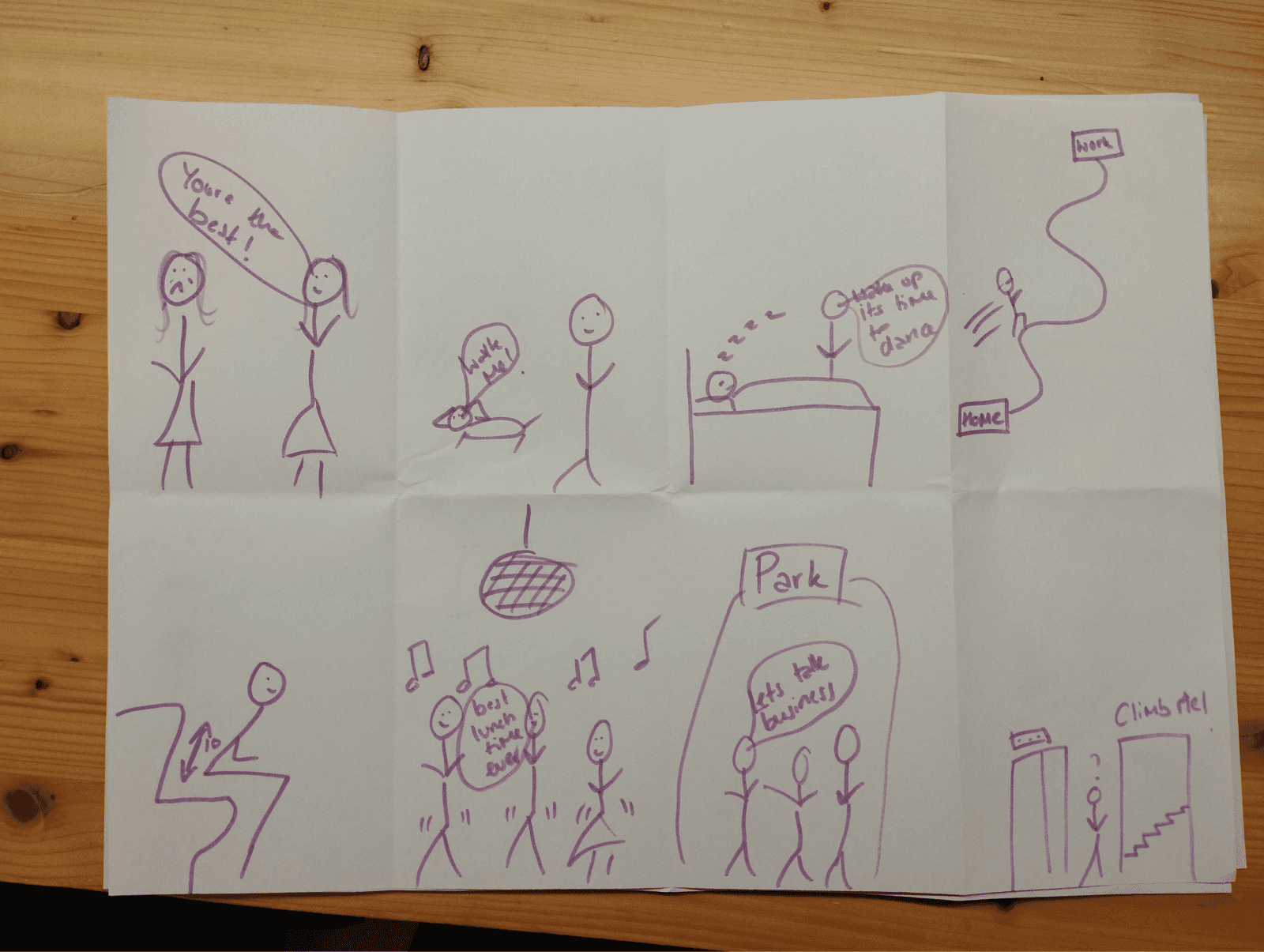
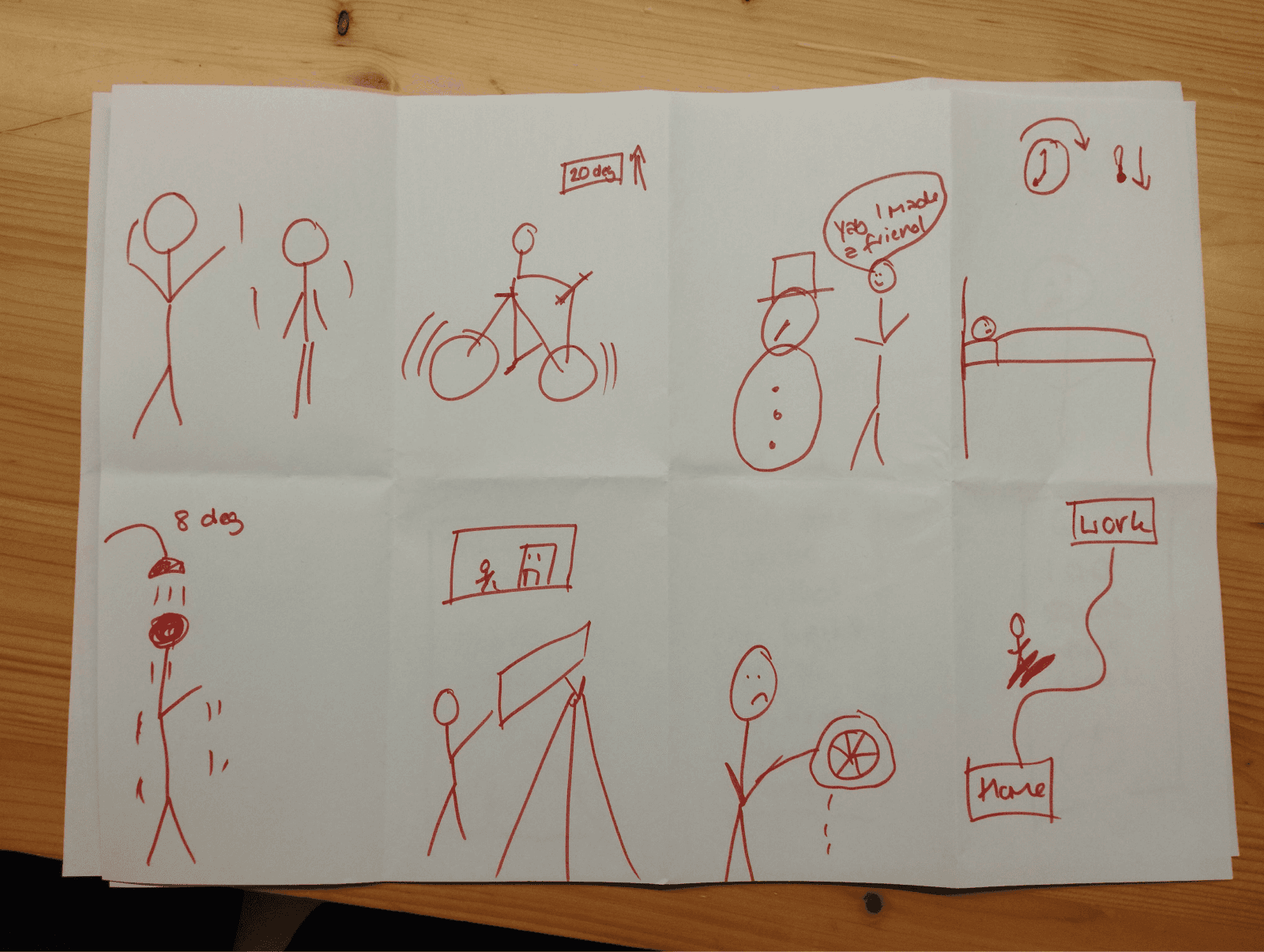
Ideation: Crazy 8s, eight ideas in eight minutes, sketched around everyday moments where movement could fit in.
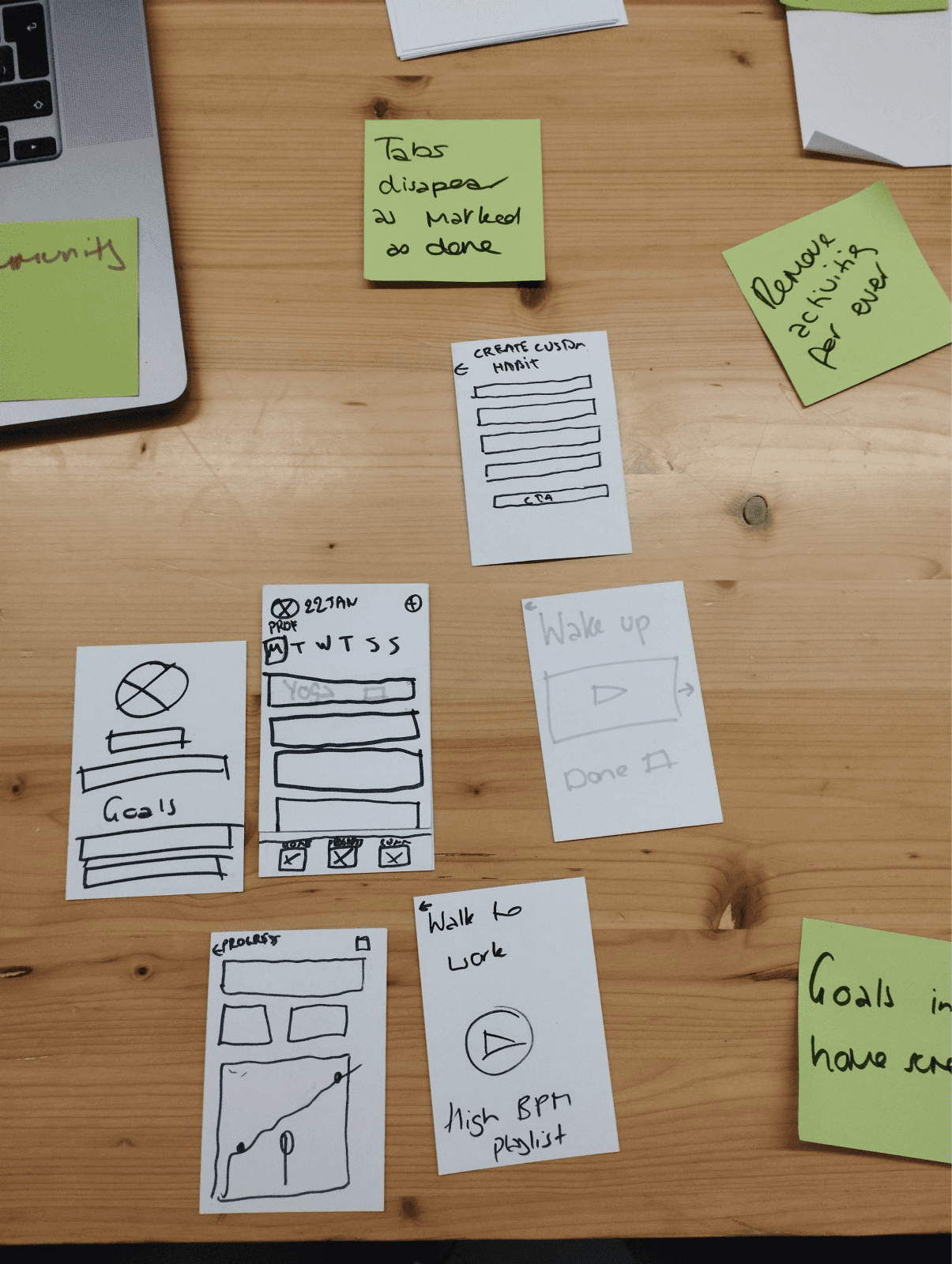
First iteration
Second iteration
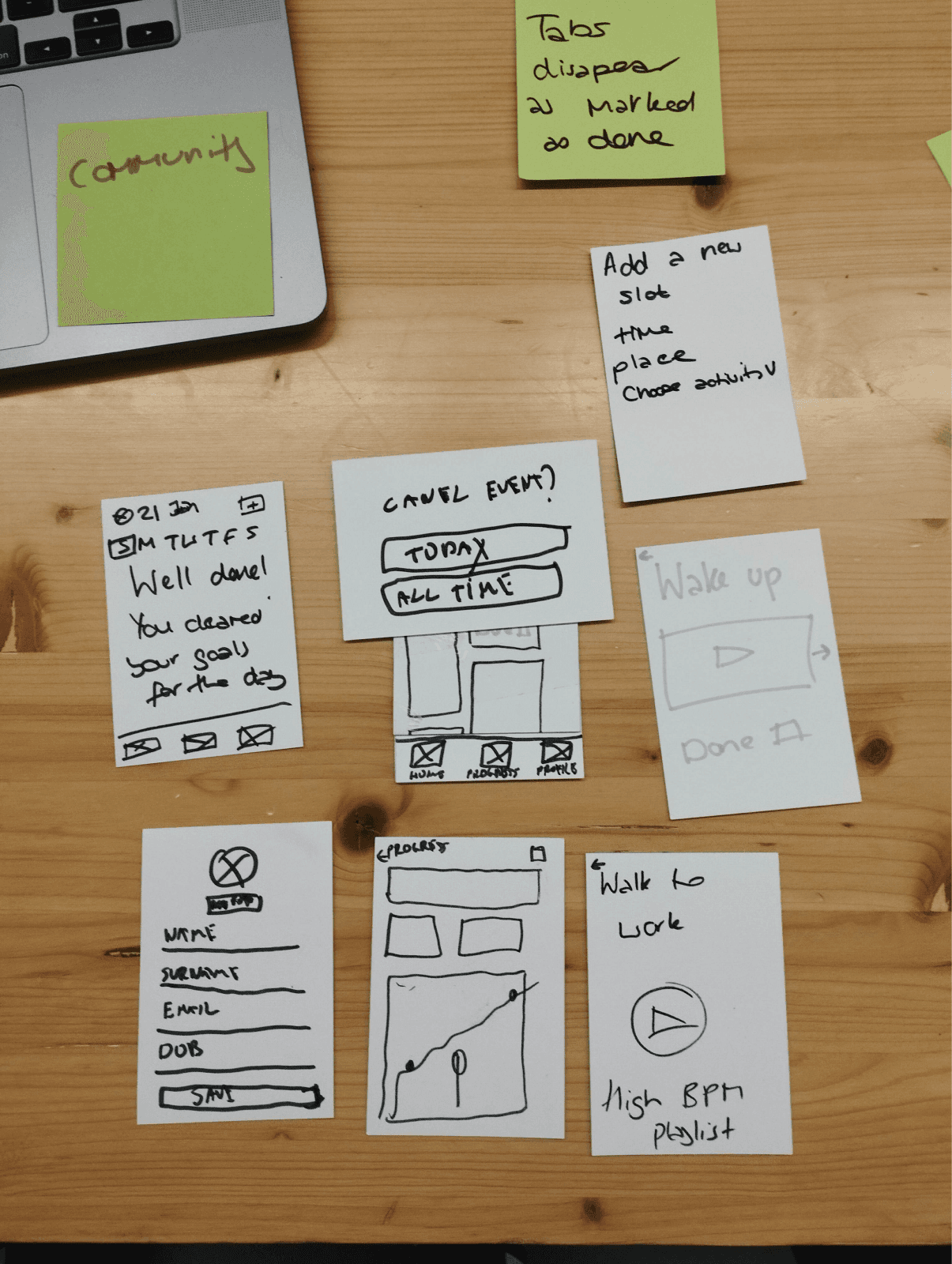
Paper sketches came before Figma. The second round added a “well done” screen for when the day’s stacks are cleared, and replaced deleting an activity forever with a choice: cancel it for today, or for good.
01 Log in
02 Create a stack
03 Today’s stacks
04 Timer
05 Progress
Mid-fidelity wireframes of the daily loop, from logging in to checking progress. These are the screens people tested before the final UI.
05 Visual design
Colour, type and tone
The brand had to feel fast, proactive, energetic and motivating. Purple carries the actions, a lime green adds energy, and black and white keep the screens clean. Open Sans runs throughout, from 24px titles to 16px body text.
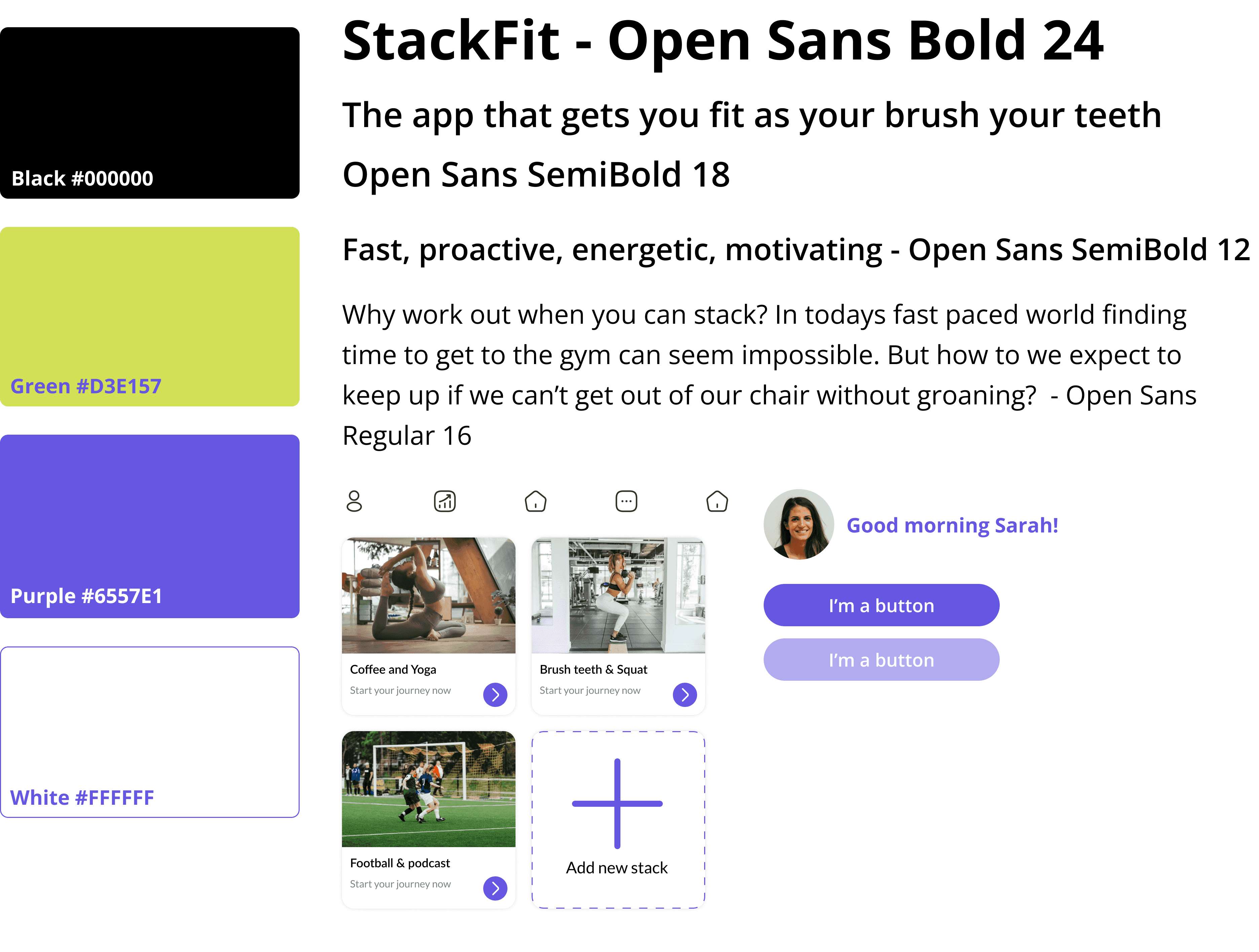
Style guide with the tagline “The app that gets you fit as you brush your teeth”, type scale, buttons and stack cards.
06 Solution
Four flows, from first launch to a streak
Interactive prototype
See it in use
A recording of the clickable Figma prototype we built to test and present the flows, starting with creating a stack. The four flows below break it down screen by screen.
01
Onboarding
A login screen, then three short intro screens that explain the idea of stacking before the app asks for anything.
02
Create your first stack
An empty home points straight to the first stack. Creating one takes four answers: which habit to build on, how many minutes, which exercise, and on which days.
03
Do the stack
Today’s stacks sit under the week, split into To do and Done. Tapping one starts a timer, and when the list is empty the app tells you you’ve cleared all your stacks.
04
Stacks, profile and progress
My Stacks lists every stack with quick edit and delete. The profile keeps the account details, and the progress page shows the current and longest streak, which you can share with friends.
07 Key decisions
From research finding to screen
Four decisions shaped the app. Each one starts from something the interviews or the competitor review showed.
01
Build on habits, not free time
Finding: time was the main barrier
A stack is an existing habit plus an exercise and a number of minutes. The habit is the reminder, so nobody has to find an empty slot in the day.
02
The user sets the routine
Finding: fixed plans ignore how much time people have
Creating a stack takes four answers: the habit, the minutes, the exercise and the days. People build their own routine instead of following a plan.
03
Make small wins visible
Finding: small wins keep people going
Each stack moves from To do to Done, and clearing the day gets its own screen. Finishing something small should feel like progress.
04
Streaks for accountability
Finding: people wanted progress tracking to stay accountable
The progress page shows the current and longest streak, and it can be shared with friends, so keeping the streak going has a social side.
08 Measuring success
How I’d know it works
StackFit was never built, so there are no live numbers. These are the metrics I’d track in a first release, each tied to the hypothesis that stacking exercise onto existing habits makes people more consistent.
Activation
First stack created
Share of new users who create a stack in their first session. Tells me whether the idea is clear after onboarding.
Engagement
Stacks done per week
How many planned stacks actually move to Done. Tells me whether the habit is a strong enough trigger.
Retention
Active after 7 and 30 days
Users still completing stacks, and how long their streaks run. The real test of the hypothesis.
Usability
Time to create a stack
To measure in the next round of testing. If setting up a stack takes longer than the workout, the flow has failed.
09 Looking back
What I took from it
What I learned
StackFit was one of my Ironhack projects, built with one other designer. It was my first time running the whole process in a short sprint: interviews, journey mapping, wireframes, testing and visual design.
Designing for someone else’s routine
I like staying active, but I don’t follow stack-based routines myself. I couldn’t design from my own habits, so the interviews had to carry the decisions.
What I’d do next
Test the key flows again with more people, then build a small MVP with a developer and try it with a group of real users to see whether the streaks keep them coming back.
Status
StackFit is a concept from Ironhack. It hasn’t been built.